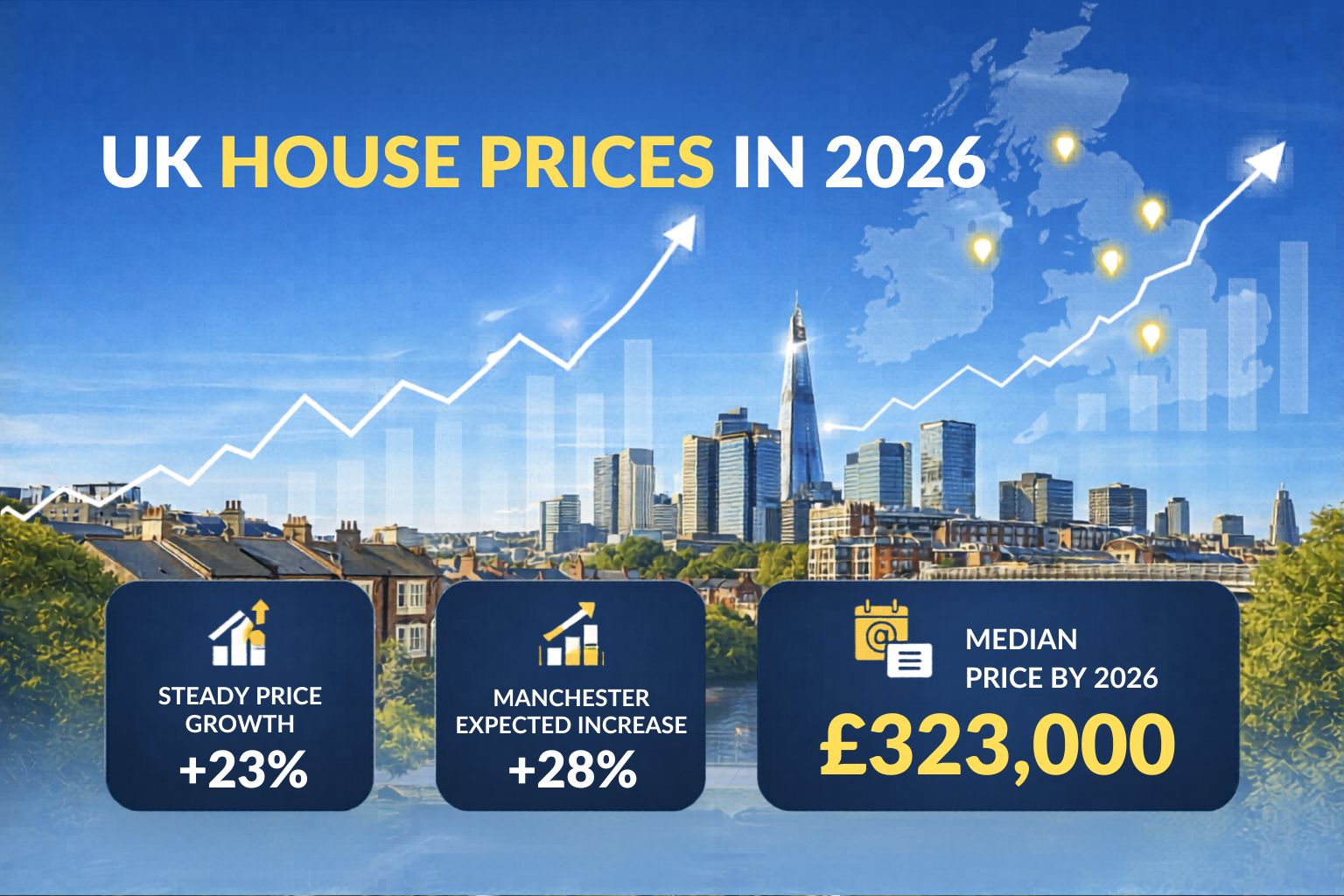
The UK Property Market in 2026: Where Are We Now?
The UK housing market has entered 2026 on a note of cautious optimism. After a turbulent few years shaped by post pandemic price surges, aggressive Bank of England rate rises, and subdued consumer confidence, the market is now finding its footing. National house prices are growing modestly, the rental sector remains exceptionally tight, and regional divergence, particularly between London and the North, is more pronounced than at any point in recent memory.
For domestic and international property investors alike, 2026 represents a pivotal window. Understanding where prices stand today, where they are heading, and which regions offer the strongest fundamentals is essential before committing capital. This guide draws on the latest official data from the ONS UK House Price Index, HM Land Registry, Zoopla, Halifax, and leading property consultancies Savills and JLL to give you the clearest possible picture.
| National Headline Figures: What Does the Data Show? | Current Position |
|---|---|
| Average UK House Price, ONS UK House Price Index, January 2026 | £268,421, a 1.3% annual increase compared with January 2025 |
| Month on month movement from December 2025 | Prices edged down by 0.3% |
| Zoopla index, February 2026 | £270,500, also up 1.3% year on year |
| Halifax data, March 2026 | Monthly dip of 0.5% to £299,677 |
| Rightmove average asking price, March 2026 | £371,042 |
According to the ONS UK House Price Index, HPI, the average UK house price stood at £268,421 in January 2026, a 1.3% annual increase compared with January 2025. On a month on month basis, prices edged down by 0.3% from December 2025, reflecting typical winter seasonality rather than any structural weakness in the market.
Zoopla's index, which draws on sold prices, mortgage valuations, and agreed sales, puts the figure slightly higher at £270,500 for February 2026, also up 1.3% year on year. Halifax's most recent data for March 2026 shows a monthly dip of 0.5% to £299,677, which the lender attributes partly to renewed mortgage rate pressure linked to broader geopolitical uncertainty. Rightmove, which measures asking prices rather than completed transactions, recorded an average of £371,042 in March 2026, a higher figure that reflects seller ambition as much as market reality.
The picture that emerges is one of a market that is broadly stable: growing, but not booming. Annual growth of around 1.3% in real terms is below historical long run averages but represents a healthy base from which analysts expect acceleration in 2027 and beyond.
Regional Breakdown: A Market of Two Halves
The headline national figure masks dramatic regional variation. The UK property market in 2026 is emphatically not a single market, it is a collection of distinct local economies, each responding differently to interest rate movements, employment trends, and housing supply constraints.
| Region / Nation | Avg. Price, Jan 2026 | Annual Change |
|---|---|---|
| United Kingdom | £268,000 | +1.3% |
| England | £290,000 | +1.1% |
| North West | ~£210,000 | +3.1% |
| Yorkshire & Humber | ~£195,000 | +2.4% |
| Wales | £210,000 | +2.0% |
| Scotland | £188,000 | +1.3% |
| South East | ~£360,000 | ,0.5% |
| London | £554,000 | ,1.7% |
Source: ONS UK House Price Index, January 2026 | HM Land Registry
The North West: The Standout Performer
The North West has emerged as the clear standout in the UK's regional league table. Prices rose by 3.1% in the twelve months to January 2026, the highest annual growth of any English region. Manchester sits at the heart of this performance: the city's combination of a young, growing population, strong graduate retention, expanding tech and media sector employment, and relative affordability compared to London continues to drive demand well above supply.
Within Greater Manchester, average prices range from approximately £180,000 in parts of Salford and Oldham to well above £400,000 in sought after areas such as Didsbury and Sale. New build city centre apartments, a product category particularly relevant to international investors, are typically priced between £250,000 and £450,000, with rental yields of 5% to 6.5% per annum, according to JLL.
London: A Market Under Pressure
London tells a very different story. The capital recorded an annual house price decline of 1.7% in January 2026, the sixth consecutive month of falls, and the average price fell a further 0.8% month on month. At £554,000, London remains by far the most expensive property market in the UK, and stretched affordability is the primary culprit behind its underperformance.
This does not mean London is without opportunity. Prime Central London micro markets, Kensington, Chelsea, Mayfair, remain globally sought after, and JLL projects Greater London will outperform the national average over the five year period to 2029 as new housing supply in the pipeline remains extremely constrained.
Wales and Scotland: Steady, Affordable Growth
Wales recorded 2.0% annual growth to reach an average of £210,000, while Scotland grew by 1.3% to £188,000. Both nations benefit from relative affordability, different stamp duty regimes, and growing remote working driven demand from buyers seeking more space. The North East of England, while not featuring in the headline HPI breakdown, is posting some of the strongest rental inflation data, 7.6% in the twelve months to February 2026, underlining the breadth of the North's outperformance.
Mortgage Market & Transaction Activity
The mortgage market is the engine room of UK house prices, and its condition in early 2026 continues to shape both buyer confidence and pricing outcomes. There were 62,584 mortgage approvals in February 2026, down from 65,114 in February 2025, reflecting the dampening effect of persistent borrowing costs on buyer volumes.
The Bank of England held its base rate at 4.5% through the early part of 2026. While several cuts were anticipated, geopolitical events, including renewed tensions in the Middle East, have pushed market expectations for further reductions back, causing some lenders to withdraw sub 4% mortgage deals. The average two year fixed rate sat close to 4.5% to 5.0% in early 2026, keeping first time buyer affordability under strain. However, a meaningful proportion of buyers, approximately one in four transactions, are cash purchases, providing a buffer against rate sensitivity and sustaining transaction volumes across the market.
On the supply side, there were 37,300 new house building starts in England in Q4 2025, a 23% increase on the previous quarter, a positive signal that Labour's housebuilding reform agenda is beginning to filter through. Completions also rose 9% quarter on quarter to 36,720. Whether this trajectory is sustained enough to address the structural undersupply that underpins long run price growth remains the central question for the decade ahead.
The Rental Market: Sustained Pressure, Strong Yields
The UK private rental market continues to outpace house price growth in terms of the pressure it is exerting on households, and the income it is generating for landlords. Average UK monthly rents rose to £1,374 in February 2026, a 3.5% annual increase. England saw rents reach £1,430 per month, +3.6%, Wales £828, +5.5%, and Scotland £1,022, +2.4%.
Within England, the North East recorded the steepest rental inflation at 7.6%, while London saw the lowest growth at just 1.7%, indicative of a market already pushing against a ceiling of tenant affordability. Nationally, the UK average rental yield stands at approximately 5.8%, making buy to let investment an attractive income proposition for those with the equity position to navigate current mortgage costs.
Manchester's rental market deserves particular mention. Average monthly rents in the city now sit at approximately £1,330, with city centre apartments commanding yields between 5% and 6.5%. With 62% of Manchester residents renting rather than owning, one of the highest proportions of any major UK city, demand fundamentals are as strong as anywhere in the country.
Expert Forecasts: What Lies Ahead?
Major property consultancies and lenders are broadly aligned on a theme of steady rather than spectacular near term growth, with stronger gains expected from 2027 onwards as interest rates continue to ease. The table below summarises the most authoritative published forecasts as of Q1 2026:
| Forecaster | 2026 Growth Forecast | 5 Year Outlook, to 2029/2030 |
|---|---|---|
| Savills | +2.0% | +20% cumulative, UK, N. West +29.4% |
| JLL | +3.5% | +19.9% cumulative |
| Halifax / Nationwide | +3,4% | Steady, accelerating by 2028 |
| Rightmove | +2.0% | Buyer affordability improving |
| Zoopla | +1.3% | Stable; North outperforms South |
Sources: Savills Residential Forecasts 2026, 2030; JLL Residential Market Forecasts; Halifax HPI; Rightmove HPI; Zoopla HPI, Q1 2026
Savills has revised its 2026 UK forecast down to 2%, from an earlier estimate of 4%, citing Oxford Economics' expectation that the Bank of England will deliver only 50 basis points of cuts in 2026, rather than the 100bps previously anticipated. However, Savills' longer term outlook remains highly constructive: it projects cumulative UK price growth of around 20% to 2030, with the North West delivering a standout 29.4% gain over five years.
JLL is marginally more bullish for 2026 at 3.5%, forecasting 19.9% cumulative growth to 2029. Notably, JLL also singles out Greater London for outperformance over the five year period, projecting 21.6% cumulative growth, driven by the chronic shortage of new homes in the capital's delivery pipeline.
For Manchester specifically, forecasters' consensus for 2026 sits in the 3% to 5% range. The city's structural drivers, population growth from approximately 422,000 to around 600,000 since 2000, with a further 30,000 residents projected over the next six years, major infrastructure investment including the Victoria North regeneration scheme worth £4 billion, and a youthful demographic profile, underpin confidence that Manchester will continue to outperform the national average for years to come.
What This Means for Property Investors in 2026
For investors considering entering or expanding their UK property portfolio in 2026, the data points to several clear conclusions:
- The North outperforms the South. Every affordability metric and analyst forecast points in the same direction. Investors seeking capital growth should weight their portfolios towards the North West, Yorkshire, the Midlands, and Northern Ireland.
- Manchester is the premier regional investment city. With rental yields of 5% to 6.5%, forecast annual price growth of 3% to 5%, strong population growth, and world class developer activity including Renaker's city centre pipeline, Manchester offers a compelling combination of income and capital return.
- London offers selective opportunity. Prime Central London remains a globally liquid store of value, and the long term supply constraint in Greater London makes the five year case compelling, though investors must be prepared for subdued near term performance.
- The rental market remains a structural tailwind. With undersupply chronic and the private rented sector under regulatory pressure from the Renters' Rights Act, well located, high quality rental property should command strong, durable yields.
- Mortgage rate trajectory matters. If the Bank of England delivers more cuts than currently priced in, the upside scenario for UK house prices, particularly in mid market owner occupier territory, could be significantly stronger than current consensus forecasts suggest.
Ready to Invest in UK Property?
Pin92 Group Limited is your trusted partner for property solutions in the UK, Dubai, and Italy. As an authorised sales agent for Renaker, Manchester's leading developer, we connect investors with premium off plan and ready to move properties that deliver strong yields and long term capital growth.
Contact us today
info@pin92.uk | +44 7436 899600 | pin92.uk
Also Read This
UK Property Market Forecast 2026: Where to Invest Now